
Attention as a Market

There is a popular claim that the attention span of the average human has shrunk to less than that of a goldfish. It is a convenient narrative, but it does not withstand scrutiny.

The widely cited comparison originated from a misinterpretation of a 2015 report by Microsoft and was later amplified by media outlets without strong scientific backing. Evidence does not suggest that our capacity for focus has meaningfully diminished. Instead, it indicates that people have become increasingly selective about what deserves their time and attention.
This adaptability has created a new dynamic in digital markets, where human attention increasingly functions as a form of value rather than simply a byproduct of consumption. Right now, platforms compete not just for users, but for the seconds of focus users are willing to allocate. In this sense, attention behaves similarly to capital: it flows toward content that delivers the highest perceived return in relevance, entertainment, or utility.
This shift has been unfolding for years as the internet gradually learned how to price human focus. Social platforms like TikTok make this visible, converting captured attention into revenue with industrial efficiency through advertising and algorithmic distribution.
At the same time, the window for engagement has compressed to just a few seconds. As AI continues to lower the cost of producing content, the supply of information expands dramatically. Paradoxically, this makes attention even scarcer and therefore more valuable.
From Cash Flow to Attention
Traditional finance recognises two core asset types:
Cash Flow Assets — equities and bonds generating investor returns through earnings
Supply & Demand Assets — commodities and currencies whose prices respond to market dynamics.
Crypto has effectively introduced a third category: assets valued largely on attention.
These attention assets include NFTs, creator tokens, and memecoins. They function as cultural focal points whose prices rise and fall alongside public interest and narrative momentum.
The value of any such asset is determined by two forces: fundamentals and attention. In the case of memecoins, almost all of the value comes from attention, with little or no underlying fundamentals. They matter culturally but lack financial depth or structural durability.
A more mature form of attention asset would provide direct exposure to measurable human focus and reward traders for identifying when that focus is mispriced.
If markets could trade attention itself, they would begin to aggregate collective beliefs about what will capture human interest next. Over time, fragmented opinions would converge into shared forecasts about attention flows.
Properly designed, attention assets could evolve beyond memes and speculation and emerge as a credible new asset class built around one of the scarcest resources of the digital age.
The Acceleration of Attention Markets
This compression of engagement cycles is not limited to social media. It is increasingly visible in financial markets that are built around attention.
Memecoins provide the earliest example of this dynamic. They function as a primitive form of attention markets, allowing participants to speculate directly on visibility and narrative momentum. Market capitalisation tends to follow engagement. When a token trends socially, its price often follows.
While insiders and market structure can introduce distortions, the relationship between visibility and valuation generally holds.
As engagement cycles across the internet continue to compress, speculation in these markets accelerates. Earlier memecoin cycles often lasted months or even years. Tokens such as Dogwifhat managed to sustain cultural relevance for extended periods. Today, however, new tokens can reach billion-dollar valuations and collapse within hours.
This shift mirrors broader internet behaviour, where the lifespan of trends continues to shrink and capital rotates more rapidly between narratives.
At the same time, token creation itself is approaching an inflection point. Launch volumes are rising steadily, resembling the early trajectory of platforms like YouTube as they transitioned from gradual to exponential content production.
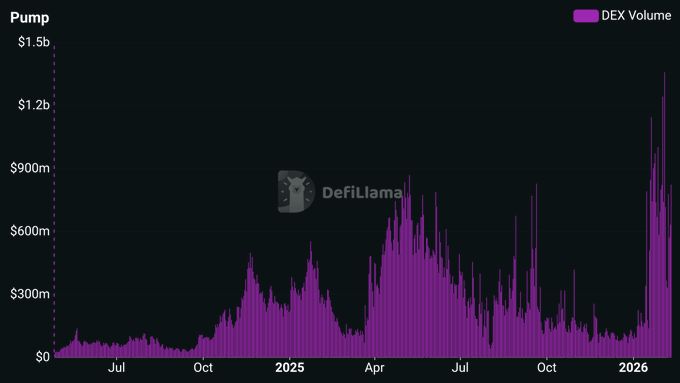
These conditions favour a new category of speculative consumer applications built around attention assets. Some emerging platforms already link token performance directly to viewer engagement, effectively turning streams or social activity into tradable signals of interest. In doing so, they merge entertainment, speculation, and product design into a single feedback loop.
Competition between platforms therefore, increasingly revolves around capturing and sustaining attention. Growth becomes a contest for mental real estate rather than physical resources.
Platforms are no longer monetising only transactions. They are monetising participation, time, and focus, treating attention with the seriousness once reserved for commodities.
Capturing Attention Is Not the Same as Keeping It
Capturing attention is only the first stage of the attention economy. Sustained engagement depends on balancing three forces: activation, retention, and reactivation.
In other words, attracting attention is not the same as keeping it.
Retention data illustrates this tension clearly. A six-month creator retention rate of roughly 67% may initially appear healthy. However, deeper analysis shows that many creators remain active not because they are committed to the platform, but because they are still hoping for a big win.
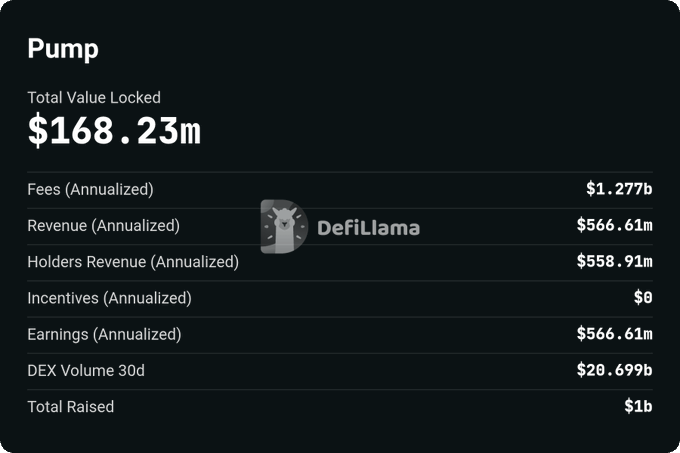
This behaviour becomes visible in token graduation data. Token graduation refers to the stage where a token successfully attracts sustained community participation and liquidity.
Over time, graduation rates have declined even as token creation has accelerated.
At the same time, the number of tokens launched per creator has reached record levels, peaking at roughly 3.25 tokens per creator. This imbalance suggests that creators are becoming increasingly aggressive while buyers grow more cautious.
When creation accelerates while success rates fall, markets begin to exhibit high-churn behaviour that resembles gambling more than sustainable product building.
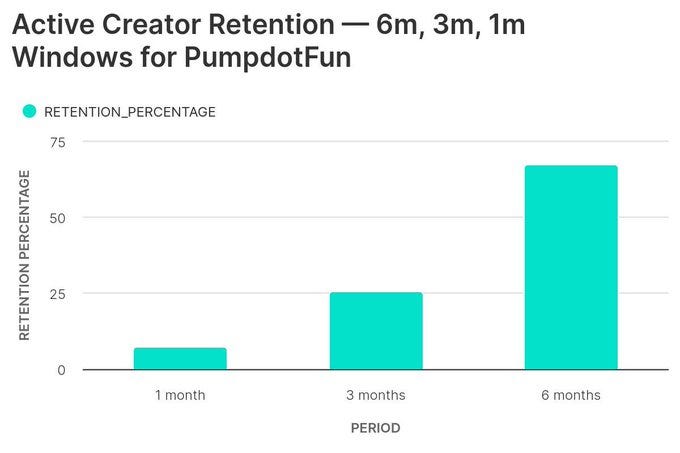
Market sentiment plays a decisive role in these cycles. Periods of rising prices in ecosystems such as Solana and expanding liquidity tend to coincide with spikes in token creation and speculative activity.
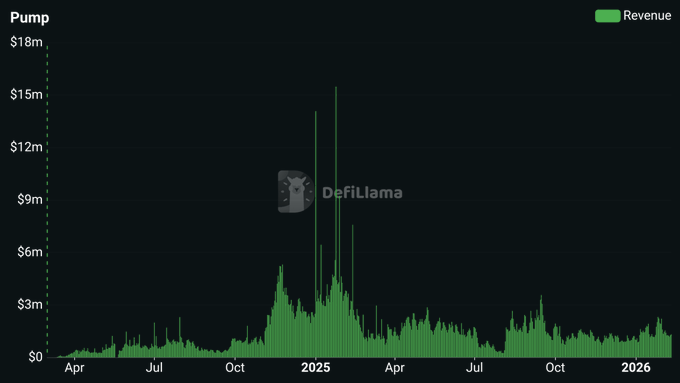
Attention markets, in other words, remain tightly coupled to liquidity cycles.
Creator Capital Markets
While memecoins represent the speculative edge of attention markets, creator capital markets represent a more structured evolution of the same idea.
Creator capital markets transform influence into an investable asset. They provide streamers and influencers with tools to tokenize their audiences so engagement can be owned, traded, and financially expressed.
Streamer tokens tie value directly to fan interaction, allowing supporters to participate in a creator’s growth rather than simply observe it.
Early results indicate meaningful demand. Some creator tokens have reached market capitalisations in the tens of millions, while creator activity tends to increase following token launches.
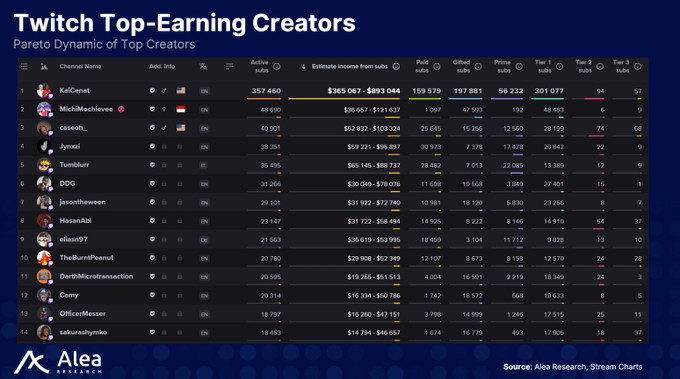
In certain cases, daily revenue generated from tokenized communities begins to rival earnings from platforms such as Twitch and Kick. The key difference is that value flows more directly to creators rather than to platform intermediaries.
For fans, this changes the nature of participation.
Instead of remaining passive viewers, they become stakeholders who benefit when a creator grows. As popularity increases, token demand rises, rewarding those who supported the creator early.
Loyalty, attention, and financial incentives become part of a single feedback loop.
This structure makes it possible to invest in emerging creators before they achieve mainstream recognition.
Building Attention Oracles
Despite its growing economic importance, attention remains difficult to measure accurately.
For attention to become a tradable asset class, markets require reliable mechanisms to quantify engagement. These mechanisms can be described as attention oracles: systems designed to convert engagement signals into measurable values that can support long and short positions.
Without reliable measurement, attention-based markets remain vulnerable to manipulation.
Simple social media metrics are insufficient. Follower counts, likes, and mentions can be easily inflated, and they rarely scale linearly with genuine engagement. Additionally, global audiences are fragmented across multiple platforms, making comprehensive measurement challenging.
This problem is captured by the economic principle known as Goodhart’s Law: once a metric becomes a target, it tends to lose its effectiveness as a measurement.
If attention is to function as an asset, its measurement infrastructure must be resistant to these distortions.
Prediction Markets as a Solution
One possible approach to constructing attention oracles is through binary prediction markets.
These markets can be created around measurable milestones such as follower counts, awards, viral events, or other public achievements. Each market captures collective expectations about a specific event.
By aggregating many such markets together, it becomes possible to approximate an overall attention index.
Each market would be weighted according to liquidity, significance, and time to resolution, producing a composite signal about expected attention levels.
Prediction markets also introduce natural hedging mechanisms. Traders could balance short positions on an attention index with long exposure to its constituent markets, reducing volatility and limiting arbitrage opportunities.
While imperfect, prediction markets allow attention measurement to emerge from collective market intelligence rather than relying on a single centralised metric.
Design Considerations
Constructing a robust attention oracle requires balancing four factors:
Input relevance – Does the data accurately reflect attention?
Acquisition practicality – Can it be collected efficiently?
Manipulation resistance – Can the metric be gamed?
Aggregation methodology – How should diverse inputs be combined?
Prediction market approaches work best for high-profile subjects with active and liquid markets, such as celebrities or public figures.
In practice, the most reliable attention oracles will likely combine multiple data sources.
Social media activity, search behaviour measured through Google Trends, and large language model analysis of news and trending content can all contribute to a composite measure of attention.
Machine learning models can filter spam, remove irrelevant signals, and isolate genuine engagement patterns.
The result would be a more accurate representation of where collective human focus is actually flowing.
Such hybrid systems would allow markets to track attention with far greater precision than traditional social media metrics alone.
Emerging Attention Capital Markets
A growing number of platforms are already experimenting with these ideas.
Projects such as Kaito AI have attempted to quantify high-quality crypto-Twitter attention, contributing to the rise of InfoFi. In this model, market incentives determine where attention flows rather than relying solely on algorithmic feeds.
Similarly, Wallchain is developing infrastructure aimed at AttentionFi, while platforms like Noise(dot)xyz plan to leverage attention data to enable traders to take long or short positions on emerging narratives.
These systems represent early attempts to formalise attention as a tradable signal within financial markets.
The Everything Social App
These developments point toward a broader transformation in consumer applications.
The next generation of social platforms is converging streaming, feeds, tipping, and financial participation into unified on-chain ecosystems.
Platforms such as Telegram, WeChat, and Binance Square illustrate how social interaction and financial infrastructure can increasingly overlap.
In such environments, every interaction can connect to token flows and digital wallets. Social identity becomes directly linked to economic participation.
Attention therefore, becomes the ultimate scarce resource.
Platforms that can capture and sustain attention develop powerful network effects and defensible advantages.
Mechanisms that once fuelled speculation can evolve into circular creator economies where engagement itself becomes measurable value.
This process also drives verticalisation across consumer applications. Just as fintech once unbundled traditional banking, creator economies may fragment into specialised platforms for music, ideas, communities, and individual creators.
AI and low-code development tools further accelerate this shift by reducing production costs and enabling rapid experimentation with token-coupled applications.
The resulting growth loop can be summarised simply:
Attention → Emotion → Action → Retention.
Applications generate attention, convert it into economic activity, and then either scale or exit, creating a repeatable cycle of growth.
Investment and Market Implications
For investors, the emergence of creator capital markets represents a new frontier following the rise of DeFi and asset tokenisation.
These markets extend tokenisation beyond financial assets to human capital itself.
Both retail and institutional participants gain exposure to cultural production by investing in creators, narratives, or attention trends.
If this model scales successfully, it could extend across music, gaming, sports, and other creative industries. Tokens may eventually represent fractional exposure to influence, intellectual property, or digital revenue streams.
In essence, the model represents a high-beta bet on the financialisation of creativity.
Risks will largely remain, from regulatory scrutiny to speculative saturation, but the trajectory has been defined, and that is the fact that attention has emerged as an asset class, and that several infrastructures are being developed to support its trading and monetisation.